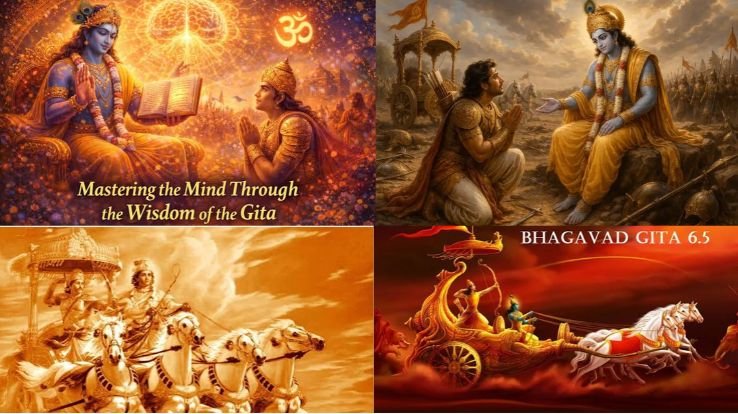
How yogic wisdom and the Bhagavad Gita reveal the path to mental mastery.
The Bhagavad Gita is often regarded as a spiritual guide, but it also powerfully reflects the human mind. The story begins with Arjuna, a skilled warrior overwhelmed by fear, confusion, and emotional conflict on the battlefield of Kurukshetra. His struggle is not merely about war; it represents the inner battles people face in their own lives. Through Yogic philosophy, these experiences can be understood through the concept of Chitta Bhumi. These five stages describe the mind’s different states and its gradual movement towards balance and self-awareness.
The first stage is Kshipta, the restless mind. In this state, thoughts race endlessly, emotions run high, and concentration is difficult. Decisions are often driven by impulse rather than by wisdom. Arjuna experiences this agitation when the reality of fighting his loved ones shakes his confidence and fills him with anxiety.
The second stage, Mudha, is characterised by mental dullness. Here, the mind becomes clouded by attachment, grief, or hopelessness. A person may feel stuck, unable to think clearly or choose a direction. Arjuna’s refusal to fight and his sense of helplessness exemplify this condition, in which despair overshadows reason.
As his dialogue with Krishna unfolds, Arjuna enters Vikshipta, the distracted yet awakening state. This stage is marked by moments of understanding mixed with recurring doubt. A person begins searching for deeper truth but struggles to remain steady. Clarity appears briefly, only to be challenged by old fears and uncertainties.
The fourth stage, Ekagra, is one of focused awareness. The mind becomes steady enough to concentrate on a single goal. Distractions lose their power, and discipline takes root. Guided by Krishna’s teachings, Arjuna gradually gains a clear understanding of his responsibilities and the purpose of his actions.
The final stage is Nirodha, the highest state of mental control. It is not the absence of thought but freedom from mental turbulence. The mind becomes calm, balanced, and deeply aware. In this state, one acts without being dominated by fear, doubt, or attachment. Arjuna attains this state when he accepts his duty with conviction and inner peace.
Arjuna’s transformation offers lessons that remain relevant today. Everyone moves through periods of confusion, distraction, and uncertainty. The concept of Chitta Bhumi reminds us that growth is gradual. By observing the mind, cultivating awareness, and staying committed to self-development, we can move from inner conflict towards lasting clarity and peace.