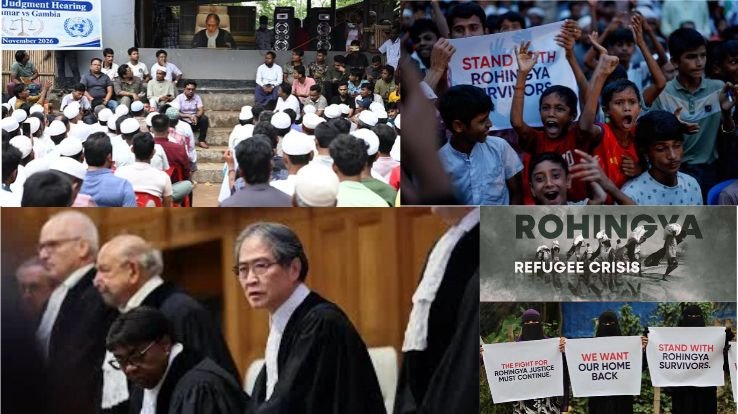
Historic UN court decision calls for justice, refugee repatriation, and accountability.
In a landmark judgment that could reshape international human rights law, the International Court of Justice (ICJ) has ruled that Myanmar committed genocide against the Rohingya people in Rakhine State. The decision marks the first time in the court’s eight-decade history that it has formally found a state responsible for genocide, a significant moment for victims seeking recognition and justice.
Announcing the verdict in The Hague, ICJ President Yuji Iwasawa outlined the court’s findings following years of investigation and legal proceedings. The judges found that Myanmar’s military campaign against the Rohingya population in 2017 involved systematic violence, including mass killings, widespread sexual abuse of women, and brutal treatment of children. According to the court, the evidence demonstrated a deliberate effort to destroy the Rohingya community, thereby fulfilling the legal definition of genocide.
The ruling highlighted that numerous Rohingya villages were destroyed and their residents forced to flee. In many cases, these settlements were later occupied by non-Rohingya populations. Judges stated that the scale and pattern of the operations left little doubt about the intent. The court found that the actions were not isolated incidents but part of a broader campaign directed at a specific ethnic and religious group.
As part of its decision, the ICJ ordered Myanmar to ensure the safe, voluntary, and dignified return of Rohingya refugees displaced by the violence. The court also instructed authorities to investigate allegations of genocide and to prosecute those responsible. In addition, the judges ruled that victims should receive compensation, although the amount and mechanism for such reparations will be determined in future proceedings.
Despite the ruling’s historic significance, questions remain over enforcement. While ICJ judgments are legally binding under international law, the court lacks direct mechanisms to compel compliance. Nevertheless, the decision is expected to intensify diplomatic pressure on Myanmar’s leadership and strengthen calls for accountability from the international community.
For the more than one million Rohingya refugees living in overcrowded camps in Bangladesh, the verdict offers renewed hope after years of uncertainty. Many survivors regard the decision as long-overdue recognition of the suffering they endured. Families who lost loved ones, homes, and livelihoods now hope the ruling will lead to meaningful action, justice for victims, and, eventually, a secure return to their homeland. The judgment stands as a powerful acknowledgment of their experiences and a reminder that international courts can play a crucial role in addressing severe human rights violations.