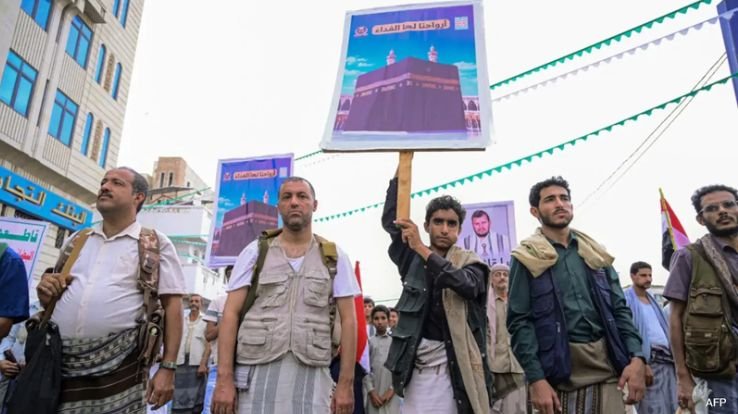
Propaganda war turns religious symbols into political weapons.
In Yemen’s protracted conflict, the Houthi movement has discovered a potent tool beyond drones and missiles: information warfare. By invoking Jeffrey Epstein, the disgraced American financier, the group is attempting to erode Saudi Arabia’s religious legitimacy and present itself as the true guardian of Islam.
The controversy stems from reports that associates of the Saudi royal court once sent Epstein tapestries that had covered the Kaaba in Mecca, Islam’s holiest shrine. The Houthis seized on this revelation, portraying it as proof of Saudi corruption and betrayal of the faith. Houthi president Mahdi al-Mashat declared that those who gave the Kaaba’s cover to Epstein are the real threat to Mecca, turning Saudi accusations of drone attacks near the holy sites back against the kingdom.
This narrative is amplified through a sophisticated communications network. What began as a small propaganda effort has evolved into a sprawling media machine that includes television, newspapers, websites, radio, and social media. Cultural influencers, comedians, and musicians echo the group’s messaging, reinforcing the image of Saudi leaders as unfit custodians of Islam. Analysts note that the Houthis’ strategy mirrors Iran’s propaganda tactics, blending religious symbolism with conspiracy theories to reach audiences far beyond Yemen.
Epstein’s name has become shorthand for Western and Israeli corruption, often invoked to bolster antisemitic tropes. Houthi leader Abdul-Malik al-Houthi frequently references Epstein in speeches, framing the Saudi struggle as part of a broader war against U.S. and Israeli influence. By linking Saudi rulers to this “Epstein class,” the Houthis aim to depict Riyadh as complicit in global corruption.
The propaganda also highlights Saudi Arabia’s devastating military campaign in Yemen, which has fuelled one of the world’s worst humanitarian crises. By combining religious legitimacy with humanitarian outrage, the Houthis seek to weaken Crown Prince Mohammed bin Salman’s standing both domestically and internationally.
Meanwhile, Saudi-backed messaging remains fragmented due to divisions within Yemen’s Presidential Leadership Council. This lack of coherence has allowed Houthi narratives to resonate even with unlikely sympathizers abroad, including conspiracy-driven influencers who admire the group’s resilience.
Ultimately, the Houthis’ exploitation of Epstein files underscores how modern conflicts extend beyond the battlefield. In this war, perception and narrative are wielded as weapons, reshaping the struggle for legitimacy in the Islamic world.